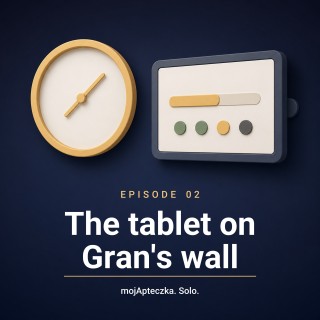
Saturday morning, twenty past nine. My phone rings. It's my mother-in-law, Joanna. She's seventy-three.
Download transcript (.vtt)
0:00
0:09
0:17
0:24
0:33
0:40
0:49
0:53
1:00
1:09
1:16
1:24
1:31
1:39
1:45
1:51
1:59
2:05
2:09
2:16
2:19
2:27
2:36
2:41
2:51
3:01
3:08
3:15
3:19
3:23
3:50
3:55
3:59
4:03
4:07
4:11
4:16
4:18
4:22
4:26
4:30
4:36
4:40
4:43
4:44
4:47
4:50
4:54
4:58
5:01
5:05
5:08
5:10
5:13
5:16
5:19
5:21
5:23
5:25
5:26
5:30
5:32
5:34
5:37
5:39
5:41
5:42
5:44
5:47
5:49
5:50
5:52
5:54
5:57
6:00
6:01
6:04
6:06
6:08
6:09
6:11
6:12
6:13
6:14
6:18
6:20
6:21
6:23
6:23
6:24
6:25
6:28
6:29
6:31
6:33
6:34
6:35
6:36
6:38
6:40
6:42
6:45
6:46
6:48
6:51
6:52
6:54
6:55
6:57
6:59
7:00
7:04
7:05
7:07
7:09
7:11
7:14
7:16
7:17
7:19
7:23
7:24
7:25
7:26
7:28
7:33
7:37
7:39
7:43
7:44
7:50
7:52
7:53
7:56
7:58
8:00
8:04
8:05
8:07
8:10
8:12
8:14
8:15
8:16
8:19
8:20
8:22
8:24
8:27
8:29
8:30
8:31
8:34
8:35
8:37
8:39
8:42
8:43
8:46
8:47
8:49
8:50
8:52
8:55
8:57
8:58
9:00
9:01
9:02
9:03
9:05
9:07
9:08
9:10
9:11
9:13
9:16
9:17
9:18
9:20
9:24
9:26
9:29
9:30
9:33
9:37
9:39
9:41
9:44
9:46
9:49
9:51
Ease a love. I've just got a quick question. That pink tablet, the one for my blood pressure,
I think I've taken it, but I took it yesterday as well, and now I can't tell whether it was twice,
because yesterday I got up, and then I got up again. And there it is. Me. Two kids, still in my
pyjamas, phone in one hand, coffee in the other. And I meant to work out whether to tell my mother-in-law,
take the pink one, or don't, you might have already. Eight medicines a day, three different consultants.
Not one of them knows what the others have prescribed.
Hello, I'm Tomasz Szuster. I built the mojApteczka app, and what you've just heard is exactly what
today's episode is about. Hi, Iza. Hi, Tomek. So, is there actually a fix for this? Because honestly,
ringing my mother-in-law and going, Mum, please, go and check your dosette box. I've done that one.
It doesn't work. There is, but before we get to it, one figure. There's a major study here in England,
thousands of people, all 65 and over, and nearly one in two of them on five or more medicines a day.
Every day. And here's the bit that stopped me. Twenty years earlier, it was about one in eight.
It's quadrupled in a generation. So it's not just Joanna's had a run of bad luck.
It's far more common than people think, right up until a phone call like that on a Saturday morning.
And here's the catch. Most of what's out there is an alarm. Or a dosette box, Monday, Tuesday, Wednesday.
Or the grown-up child ringing every four hours. And all three have the same flaw.
They need the older person to remember they've got something to check.
Well, quite. Mum, have you taken it? Because to answer yes or no,
Mum first has to remember whether she took it in the first place.
Exactly. Now, picture this. In Joanna's kitchen, on the wall next to the fridge, there's a tablet.
On all the time. On charge. And on that tablet, her page in the mojApteczka app is open. All day.
And Joanna, wandering past for her afternoon coffee, sees a progress bar.
Two of four today. Four times a day. Eight in the morning, midday. Four in the afternoon, eight at night.
Eight. Green dot. Midday. Green dot. Four. Grey. Not due yet. Eight at night. Grey.
So she's not asking herself whether she's taken it. She sees that she has.
Yes. And that's the whole trick. I don't believe in apps that turn an older person into a patient.
I believe in apps that do the counting, so you don't have to.
Hang on. Tomek, there's one thing that bothers me about this.
Good question. Look, two things it is not.
First, it's not surveillance, because Joanna's the first to see the colours.
The tablet's on her wall, in her kitchen.
She walks past first. She sees it first.
If she misses the four o'clock dose, an hour later at five,
that bar turns amber and shows the four o'clock's still due.
No shouting, no phone ringing. The screen just changes colour.
She sees it, and she decides for herself.
And if she still doesn't take it?
Three hours after the time, so at seven, if the dose was at four,
the colour turns red, and it marks that dose as missed.
In the app, it's now clear. That one's missed. Not late. Missed.
An hour to amber. Three hours to red.
Yes. And those aren't numbers I've plucked out of the air.
They're the values written into the app.
The same for every single user.
An hour late is still just life.
She nodded off in the chair, popped to the loo, got chatting to a neighbour.
Three hours, though, is a fair bet that dose never happened.
All right. And the second thing it's not?
Second, it's not a stand-in for seeing the doctor.
The tablet doesn't know whether Joanna's running a temperature.
It doesn't know her sodium's low.
It doesn't know the new tablet from the neurologist
clashes with the old one from the cardiologist.
Though, as it happens, the app does check for that.
But that's another conversation.
Another episode.
The tablet's there to prop up her memory.
Not to diagnose.
Right. That does sound honest.
Most apps do the opposite.
They pretend they'll handle the lot.
You're saying, I'll do this one thing well,
and I'm not pretending to do the rest.
Exactly.
And one more thing.
Because carers always ask this one.
Me, as the daughter or the son,
where do I come into it?
Well, exactly.
Because in this story,
I don't live in the same flat as my mother-in-law.
I'm a hundred-odd miles away.
You open the mojApteczka app on your own phone,
go to the Family tab,
and you see the very same bar Joanna sees.
A card with Joanna's name on it.
The 2 of 4 bar.
The times in colour.
The status.
Due at 4.
Or missed.
Or done.
So, I'm not getting a text at midnight saying,
Mum hasn't taken her pills.
No.
The app doesn't ring round for you.
You open it.
You see.
You decide.
If you spot an amber due at 4,
you ring and say,
Mum, have a look at the screen.
The pink one's due.
You don't drive all that way.
You don't shout.
You just ring,
because you know there's something waiting there.
It's a subtle difference,
but it's a big one.
I'm not some digital carer.
I'm family.
We're both looking at the same screen.
That's exactly it.
Right.
The practical bit.
What do I buy?
Where do I hang it?
What's it going to cost?
And can I,
a 35-year-old mum with two kids and a job,
set it up in half an hour?
The tablet.
It needn't be anything new.
An old iPad or a second-hand Android
does the job perfectly well.
Only three things really matter.
It stays plugged in,
the screen doesn't lock,
and it hangs somewhere Joanna already looks every day.
The kitchen.
By the clock,
by the calendar,
somewhere the eye naturally goes.
And how do you stop the screen going dark?
Apple and Google both have a built-in setting for exactly that.
You set it once and forget about it.
The full step-by-step guide is in the episode description.
There's a PDF.
And if Joanna accidentally unplugs the tablet?
That's the most common question, that one.
The answer?
Cable tucked behind the kitchen unit.
Extension lead round the other side.
And if she really wants to unplug it,
well, that's not the app's problem anymore.
All right.
And the last one,
because I know it's on someone's mind right now.
Data protection.
Data protection.
Yes.
Medical data on a tablet
in an older person's home.
Short version.
Joanna's account is hers.
You're not peering into her account.
She invites you into her family medicine cabinet.
That's the difference.
The tablet's hers.
The data's hers.
And she decides who's on the other side.
Right.
So it's her tablet,
her medicine cabinet,
and I'm invited.
Exactly.
And that's the whole idea behind the sandwich generation.
We don't take control.
We share the view.
By the way,
everything we're talking about here
really is a feature of the mojApteczka app.
This isn't an advert,
just so we're clear.
If you're listening to this
and there's someone in your family
on five,
six,
eight medicines a day,
do give the mojApteczka app a look.
The app is free
and works offline.
You'll find the link
in the episode description.
And if you found this episode useful,
do pass it on to someone
who knows a Joanna
or someone like her.
One more thing before we go.
This podcast is made with the help
of artificial intelligence.
I wrote the dialogue myself,
but the voices you're hearing aren't ours.
They're AI-generated synthetic voices.
We're telling you this straight out
because we think it should be the standard
for any podcast made this way.
Full details are in the show notes
and in every episode description.
Until next time.
Until next time.