
0:00Cold open: seven boxes in a carrier bag
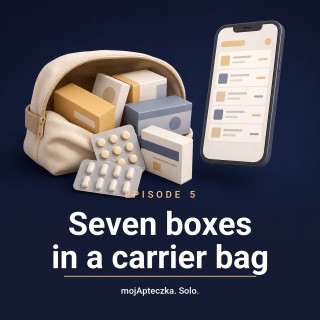
Iza empties her mum’s handbag onto the kitchen table and out come seven boxes of medicine. Seven. One from the cardiologist, two from the GP, two for her joints from the rheumatologist — and two Irena can’t even name. “The pink one” and “the little white one.” She isn’t muddled. She’s on the same road as an awful lot of people her age.
This episode isn’t about an app feature. It’s about what no single doctor sees. Taking several medicines at once has a name — polypharmacy — and it’s closer to the norm than the exception: in a large Polish study, more than four in ten over-65s were on five medicines or more, and over half of the over-80s. Each medicine, on its own, usually has a good reason behind it. The cardiologist looked at the heart, the rheumatologist at the joints. Nobody looked at the whole.
That’s how you get a prescribing cascade: one medicine causes a side effect, the next doctor treats the side effect with another medicine, and nobody walks it back to where it started. Not spite, not stupidity — just no one whose job it is to see the whole list at once.
The line we hold: the mojApteczka app doesn’t prescribe anything and doesn’t stop anything. It signals. What to actually do about a duplicate or an interaction is for the GP or the pharmacist to decide — always. Your job isn’t to be the doctor. It’s to make sure the doctor gets one full, current list instead of seven boxes in a carrier bag.
What the app actually does (and what helped that day):
Elsewhere they’ve a handle on this: in Germany, anyone regularly on three or more prescribed medicines has a right to a single, shared medication plan. Here in the UK you can get a medication review — your GP or a pharmacist going through the lot. But walking into that review with the complete, current picture — and keeping it current in between — still tends to fall to the family. At least now there’s a tool for it: one page a GP can read in ten seconds.
Materials:
⸻
About AI in this episode. The dialogue was written by Tomasz Szuster. The voices you hear are AI-generated synthetic voices — not recordings of the hosts. We say this straight out, because we think it should be the standard for any podcast made this way. Full details in the show notes and in the episode outro.